Bold and Easy Space Coloring Book Pages: A Practical Guide for KDP Publishers
What Are Bold and Easy Space Coloring Book Pages?
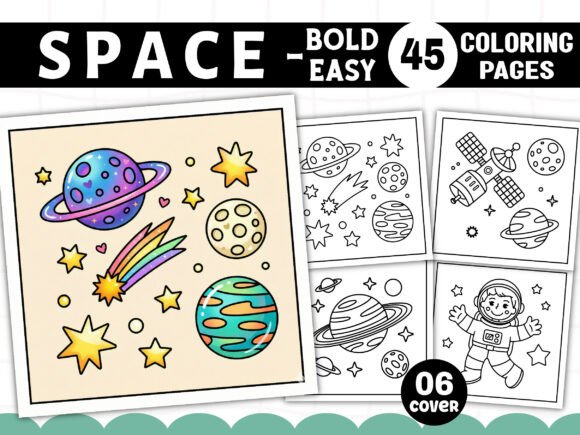
Bold and Easy Space Coloring Book Pages refer to a specific style of coloring book interior designed around space-themed imagery—planets, rockets, stars, moons, astronauts, and galaxies—using thick, heavy outlines and simplified compositions. Unlike intricate adult coloring books that rely on fine details and dense patterns, this style emphasizes clear shapes, large open areas, and minimal complexity. The product described includes a full interior package for a self-published coloring book, delivered in multiple file formats (PDF, PNG, JPG, SVG, EPS) at 300 DPI, sized at 8.5 x 8.5 inches, and presented in black and white. The package also contains 45 individual designs plus a free cover template in PNG format.
For anyone researching options for a KDP (Kindle Direct Publishing) interior, this type of product represents a ready-made foundation that can be customized or used as-is. The appeal lies not just in the space theme but in the deliberate design choice to keep each page bold and easy, which directly influences who will use it and how.
Understanding the Audience and Use Case
The term "bold and easy" signals a particular approach to coloring book design. It targets users who may feel overwhelmed by highly detailed illustrations. This includes younger children still developing fine motor skills, older adults who prefer larger areas to color without strain, or anyone seeking a low-pressure, meditative creative activity. The space theme adds a layer of curiosity and adventure, making the pages suitable for educational settings, quiet time activities, or themed gift books.
For a KDP publisher, choosing this style means aligning with a demand for accessible, stress-free content. The space niche is broad enough to attract interest but specific enough to stand out among generic coloring books. The product's file variety—PDF for print-ready interiors, EPS for professional editing, SVG for scaling, and PNG/JPG for digital previews or POD platforms—gives a publisher flexibility regardless of their technical workflow.
High Resolution and Print Readiness
At 300 DPI, each page is optimized for sharp, clean printing. This matters because low-resolution files can appear blurry or pixelated when printed, especially for line art. For a self-publisher, this eliminates a common quality control issue. The 8.5 x 8.5 square format is a popular trim size on KDP, offering a balanced canvas for space scenes without awkward cropping.
Multiple File Formats Reduce Technical Barriers
Having access to PDF, PNG, JPG, SVG, and EPS means you are not locked into a single software ecosystem. A user comfortable with Adobe Illustrator can edit the EPS files. Someone using Canva or Affinity can work with PNG or SVG. A publisher who wants a simple upload can use the ready PDF. This variety reduces the learning curve and allows for last-minute adjustments to the interior layout, page order, or cover integration.
Included Cover Template
The free 06 PNG book cover files save time during setup. Creating a cohesive cover that matches the interior style is often a hurdle for first-time publishers. Having a cover template that aligns visually with the bold-and-easy aesthetic means one less design task. However, since the cover is in PNG format, you may still need to add your own title text and author name.
Designed for All Skill Levels
The description notes that these pages are suitable for coloring enthusiasts of all skill levels. This is not just marketing language—it reflects intentional design choices. Bold lines help prevent color from bleeding outside the intended area. Large open spaces allow for experimentation with shading, blending, or simply using one flat color. This makes the pages forgiving for beginners while still offering enough structure for experienced colorists to enjoy.
Limited Complexity May Not Appeal to Everyone
While bold and easy designs attract one audience, they may repel another. Adult colorists who seek intricate mandalas, detailed landscapes, or highly realistic illustrations will likely find these pages too simple. If your target market includes experienced colorists looking for hours of detailed work, this style may feel underwhelming. The tradeoff is between mass appeal for casual users and depth for dedicated hobbyists.
Black and White Only—No Curated Color Palette
The product delivers black-and-white line art. This is standard for coloring books, but some publishers prefer interiors that include subtle gray shading or pre-colored backgrounds. The absence of any color means you have full control over the final look, but it also means the pages are completely dependent on the user's own supplies and skill. For a publisher, this is a neutral feature, but it is worth noting that some competitors offer interiors with light background patterns or tinted pages.
45 Designs: Adequate but Not Extensive
Forty-five unique pages is a reasonable count for a standard coloring book. A typical KDP coloring book ranges from 40 to 80 pages depending on the price point and target audience. If you plan to sell at a higher price, you may need to supplement with additional content, your own designs, or a second volume. The page count is enough for a lean, focused book but not for a "mega" collection.
Square Format Limits Some Layout Options
The 8.5 x 8.5 inch size works well for portrait and square themes, but it is less common than the standard 6 x 9 or 8.5 x 11 inch formats. Some print-on-demand platforms treat square books differently in terms of pricing, page count calculations, and cover templates. Check KDP's guidelines for square trim sizes before committing to ensure your expected production cost aligns with your pricing strategy.
Situations Where This Is a Strong Fit
- First-time KDP publishers: The ready-to-upload format and multiple file types reduce technical friction. You can focus on cover design, pricing, and marketing rather than creating original artwork.
- Publishers targeting children or seniors: The bold lines and simple shapes are well-suited for these demographics. The space theme also works well for educational or themed activity books.
- Publishers expanding a series: If you already have a "Bold and Easy" line with other themes (animals, fantasy, nature), adding a space volume creates coherence across your catalog.
- Budget-conscious creators: Buying a complete interior is far less expensive than commissioning original illustrations. The cost per design is low, and the range of formats adds value.
- Print-on-demand testing: If you want to test the market for space coloring books without a large upfront investment, this gives you a professional-looking interior to launch quickly.
Situations Where Alternatives May Be Better
- You want a unique, hand-drawn aesthetic: Ready-made interiors are not exclusive. Other publishers may use the same designs. If brand uniqueness is critical, consider creating your own vector-based space illustrations or hiring an artist.
- You need 80+ pages: A 45-page interior limits the thickness of your book. If you aim for a premium-priced, substantial volume, you may need to combine multiple interior packs or add your own content.
- You target advanced adult colorists: This style is intentionally simple. A more detailed space coloring book with intricate star charts, nebula patterns, or realistic spacecraft would better meet that audience's expectations.
- You require commercial license flexibility: Verify the license terms of the product. Some interior packs restrict the number of copies you can sell or prohibit certain distribution channels. Know the terms before publishing.
Practical Decision-Making Insights
When evaluating any KDP interior product, start by clarifying your goal. Are you publishing a single book as a passive income experiment, or are you building a brand with multiple titles? If you are testing the space niche, this interior offers a low-risk entry point with professional-grade files. If you plan to scale, consider how easily you can create or source additional designs in the same style to produce a series.
Check the file quality before purchase. Many sellers provide sample pages. Download them, print at actual size, and test how the lines appear on paper. Look for consistent line weight, clean scans, and no artifacts. The 300 DPI specification is reassuring, but actual print quality varies.
Consider whether you need to edit the pages. If you want to add page numbers, a table of contents, or promotional pages, the EPS or SVG formats give you the most flexibility. If you plan to upload as-is, the ready PDF is the simplest route. Understanding your own comfort with design software will guide which format you rely on most.
Pricing strategy matters. A 45-page black-and-white coloring book on KDP typically sells between $5.99 and $9.99. Factor in printing costs, Amazon's cut, and your royalty. A ready interior keeps your upfront costs low, which can allow you to price competitively while still earning a positive royalty per sale.
Assessing Alignment with Your Goals
If your primary need is a time-efficient, print-ready interior with a popular theme and accessible design, Bold and Easy Space Coloring Book Pages are a practical choice. They remove the barrier of creating original artwork while giving you a product that meets basic quality standards. The variety of formats also means you are not locked into one workflow.
If your goal is to build a distinctive brand with exclusive content, or if your target audience demands more complexity, you will likely need to invest in custom illustrations or a more intricate interior. The tradeoff between convenience and uniqueness is the central decision point. For many independent publishers, the convenience of a well-made, versatile interior outweighs the need for total originality—especially when starting out.
Ultimately, the best choice depends on how the interior fits into your broader publishing strategy, your comfort with design tools, and the specific expectations of the audience you aim to serve. The space niche is broad and evergreen, and a bold-and-easy approach offers a welcoming on-ramp for both the publisher and the colorist.