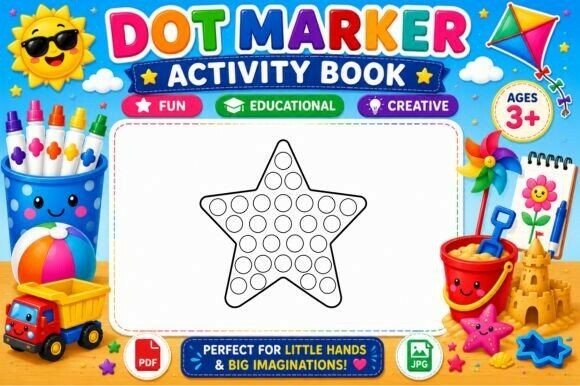
Summer Dot Marker Coloring Page: What to Look for Before You Buy or Print
If you have looked for toddler activities or preschool worksheets recently, you have likely come across summer dot marker coloring pages. These simple sheets pair large, bold illustrations with oversized dot circles so young children can stamp, dab, or paint their way through a sunny theme. The concept sounds straightforward, but there is more to a quality dot marker page than meets the eye. Many parents, educators, and self-publishers grab the first file they see, only to discover blurred lines, tiny dots that frustrate small hands, or artwork that confuses rather than teaches. Before you download, buy, or create a summer dot marker coloring page, it pays to know exactly what separates a useful resource from a disappointing one.
What a Summer Dot Marker Coloring Page Actually Does
A well-designed summer dot marker coloring page combines a recognizable summer image—like a beach ball, crab, ice cream cone, or sailboat—with large, perfectly spaced circles that fit the tip of a standard dot marker or dabber. The child places the marker inside each circle rather than coloring across the whole shape. This targeted activity builds fine motor control, hand-eye coordination, and early object recognition. For toddlers and preschoolers, the satisfaction of landing the dot exactly where it belongs reinforces focus and patience. For adults running a classroom, daycare, or homeschool, these pages offer a low-mess, high-engagement activity that requires almost no setup.
The best versions also incorporate subtle learning opportunities. A page featuring a starfish next to a seashell, for example, introduces vocabulary naturally. A page with a sun and a single cloud helps children practice counting and one-to-one correspondence. When done right, a summer dot marker coloring page is not just busy work—it is a deliberate early learning tool.
Mistake One: Choosing Designs with Circles That Are Too Small
The single most common problem with dot marker pages is dot size. Many creators design graphics without considering the physical marker kids will use. A standard dot marker has a tip roughly three-quarters of an inch wide. If the printed circles are smaller than that, the ink bleeds outside the boundary, the child gets discouraged, and the finished page looks messy instead of rewarding. This mistake is especially common in budget-friendly or hastily assembled PDFs sold online.
What to check: Before you commit to a summer dot marker coloring page, look at the circle size relative to the page dimensions. At 8.5 x 11 inches with 300 DPI, the circles should measure roughly 0.7 to 0.9 inches in diameter. Pages designed specifically for toddlers will use the larger end of that range. If the preview images show tiny circles packed tightly together, move on. The activity should feel generous, not cramped.
Mistake Two: Overly Detailed or Unrecognizable Artwork
Another frequent issue is artwork that leans too abstract or too detailed for young children. A summer dot marker page should feature thick, bold black lines that define simple, recognizable shapes. A child should be able to see the outline of a whale or a sand bucket and know immediately what it is. When the lines are thin, the outlines are messy, or the object has too many small parts, the page loses its educational value. The child struggles to identify the image and may lose interest before finishing.
A better approach: Look for pages where each image has a clear silhouette and a single, strong outline. The best summer dot marker coloring pages feature one main object per page, or at most two or three with plenty of white space between them. The white background is not an accident—it reduces visual noise and helps the child focus on the dot placement. If you are printing for a group of kids, simpler artwork also means less ink usage and faster drying times.
Mistake Three: Ignoring the Learning Potential
Many adults treat dot marker pages as pure entertainment, but this overlooks a major opportunity. A summer-themed page can reinforce vocabulary, categorization, and early math concepts simultaneously. For example, a page with a beach ball, a pair of flip-flops, and a seashell invites the adult to name each item, talk about its color, and count the dots as they are filled. A page that includes a number of objects corresponding to a numeral helps the child practice counting in context.
What creators and buyers should consider: The best interiors for a summer dot marker coloring page—especially if you plan to publish on Amazon KDP or use the pages in a preschool workbook—include subtle learning cues. A starfish page might have five dots, reinforcing the number five. A page of ocean animals might group three fish together. These small design choices turn a simple activity into a vocabulary-building and math-readiness exercise. If a page set contains only random summer images with no connection to quantity, color, or naming, you are paying for decoration, not education.
Mistake Four: Overlooking File Quality and Print Readiness
This is where the technical specs matter. A summer dot marker coloring page that looks crisp on screen can become a blurry disappointment after printing if the file is not properly prepared. Low-resolution images, incorrect color profiles, or a PDF that lacks proper bleed and margins will cause lines to feather, circles to distort, and the final product to look unprofessional.
What to demand from a file: Look for a high-quality JPG and a ready-to-print PDF, both sized exactly to 8.5 x 11 inches at 300 DPI. The lines should be thick enough to remain bold after printing on standard home or classroom printers. The background must be clean white, not off-white or cream, so the dots stand out clearly. If you are buying a KDP-ready interior, verify that the PDF has no embedded fonts that could cause substitution issues and no low-resolution preview images. One high-quality JPG and one matching PDF, as specified in the product details, give you flexibility for both digital and print use.
For self-publishers, this is doubly important. Amazon KDP interiors must meet specific formatting guidelines. A summer dot marker coloring page interior that uses poor line weight or low resolution will generate customer complaints and returns. Investing in a file set that meets professional standards from the start saves time, money, and reputation.
Mistake Five: Buying a Set with No Thematic Cohesion
Some collections of summer dot marker pages look like a random assortment of beach clip art thrown together. One page might have a dolphin, the next a seashell, then a surfboard, then a bucket. There is no narrative, no progression, no educational thread. Children respond well to thematic coherence. A set that begins with ocean animals, moves to beach objects, and then includes simple weather symbols builds a small world they can understand and talk about.
Practical advice for parents and teachers: Look for a summer dot marker coloring page set that groups related items. Pages featuring fun summer animals, beach objects, and educational items for early learning are ideal. You want a spread that includes a crab, a starfish, a sandcastle, a sun, a sailboat, and perhaps a number or a letter tied to the season. This structure helps you plan lessons or activities around the pages. It also gives the child a natural sense of completion as they move through a themed set.
Mistake Six: Using Dot Marker Pages for the Wrong Age Group
It is tempting to grab a summer dot marker activity for any young child, but age appropriateness matters. Toddlers around two years old need the largest dots and the simplest outlines—ideally one object per page with three to five circles. Preschoolers aged three to five can handle slightly smaller dots, more objects, and pages that combine dotting with counting or naming. If you give a toddler a page designed for a five-year-old, they will struggle to place the dots accurately and may become frustrated. If you give an older child a page designed for a baby, they will be bored.
How to avoid this: Read the product description carefully. Look for phrases like "perfect for toddlers and preschool kids" and check the age range. The best summer dot marker coloring page sets specify whether the dots are sized for little hands or for more advanced preschoolers. If you are buying for a mixed-age group, choose a set that offers pages with varying difficulty so each child can find something that matches their skill level.
What to Look for Before You Click Buy or Print
Before you finalize your choice, run through a quick mental checklist. First, confirm the circle size is appropriate for the markers you own. Second, look for bold black lines on a clean white background with no gray or colored fill. Third, verify the file format and resolution—300 DPI at 8.5 x 11 inches is non-negotiable for print quality. Fourth, assess the thematic variety: does the set include animals, beach items, and learning elements like numbers or letters? Fifth, check that the pages are designed to be used sequentially or grouped logically if you are building a lesson plan or a workbook interior. Finally, read any user reviews or preview pages to see actual print results rather than polished mock-ups.
Practical Uses That Maximize the Value of Every Page
Once you have a high-quality summer dot marker coloring page set, you can stretch its usefulness far beyond a single activity. Use individual pages for morning work to settle children into the day. Keep a stack of printed sheets in a binder for fast finishers who need a quiet, productive task. Laminate a few favorites and use them with washable dot markers for repeated practice. The clean white background and large circles also make these pages excellent for summer camp activities where supplies are limited and setup time is tight.
For homeschool and classroom environments, pair each page with a short vocabulary lesson. When a child dots the outline of a seashell, say the word aloud, describe the shell's texture, and count the dots together. For a beach ball page, talk about the colors and the way the ball floats on water. These small conversational moments turn a simple coloring page into a rich language and science experience. For those creating KDP interiors, these thematic ties increase the perceived value and educational appeal of your book.
Final Thoughts on Choosing a Summer Dot Marker Coloring Page
A summer dot marker coloring page seems like a simple product, but the details determine whether it becomes a cherished learning tool or a forgotten printout. The common mistakes—small dots, thin lines, unrecognizable artwork, missing learning cues, low file quality, random themes, and age mismatches—are entirely avoidable with careful evaluation. By focusing on properly sized large dot circles, bold black outlines, clean white backgrounds, and cohesive summer themes including animals, beach objects, and early learning elements, you set yourself and your child up for success. Whether you are a parent looking for quiet summer afternoons, a teacher planning preschool activities, a daycare provider stocking independent play bins, or a self-publisher building a KDP-ready interior that customers love, paying attention to these specifics makes all the difference.
Take a few extra minutes to verify the file details before you buy or print. One high-quality JPG at 300 DPI and one ready-to-print PDF, sized exactly for standard paper, give you reliability and flexibility. When a child picks up a dot marker, aims at a circle, and places the dot exactly where it belongs, that small success builds confidence. The right summer dot marker coloring page makes that moment possible again and again.